How to Measure Baking Powder and Baking Soda in Teaspoons
1 gram of baking powder equals 0.23 teaspoons and 1 gram of baking soda equals 0.18 teaspoons. Charts for 1 g to 20 g, plus how to stop flat or bitter cakes.
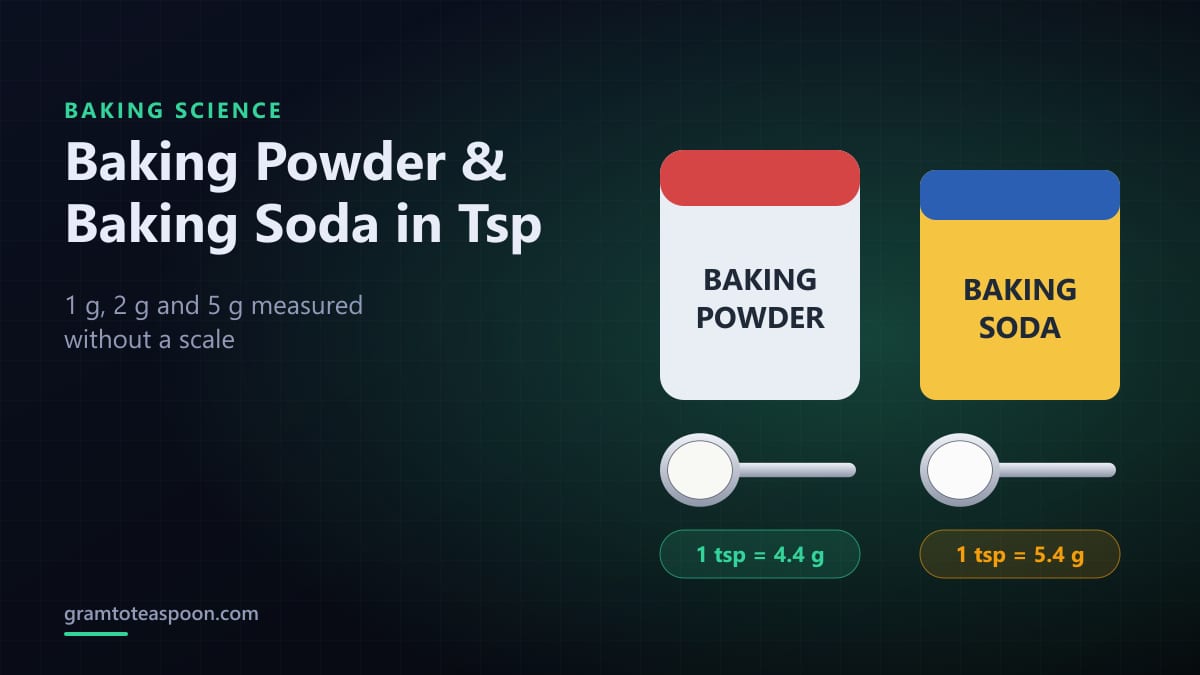
1 gram of baking powder equals 0.23 teaspoons, and 1 gram of baking soda equals 0.18 teaspoons. One level teaspoon (tsp) of baking powder weighs 4.44 grams (g). One level teaspoon of baking soda weighs 5.42 g.
Baking soda is 22% denser than baking powder. The same gram amount of baking soda fills a smaller spoon.
How to Measure Baking Powder in Teaspoons
To measure baking powder in teaspoons, divide the grams by 4.44. Baking powder has a density of 0.90 grams per milliliter (g/mL).
| Baking powder (g) | Teaspoons | Nearest spoon |
|---|---|---|
| 1 g | 0.23 tsp | ¼ tsp |
| 2 g | 0.45 tsp | ½ tsp |
| 3 g | 0.68 tsp | ¾ tsp |
| 4 g | 0.90 tsp | 1 tsp (scant) |
| 5 g | 1.13 tsp | 1⅛ tsp |
| 8 g | 1.80 tsp | 1¾ tsp |
| 10 g | 2.25 tsp | 2¼ tsp |
| 15 g | 3.38 tsp | 1 tbsp + ⅜ tsp |
| 20 g | 4.50 tsp | 1½ tbsp |
The baking powder calculator converts any gram value.
How to Measure Baking Soda in Teaspoons
To measure baking soda in teaspoons, divide the grams by 5.42. Baking soda (sodium bicarbonate) has a density of 1.10 g/mL.
| Baking soda (g) | Teaspoons | Nearest spoon |
|---|---|---|
| 1 g | 0.18 tsp | ⅛ tsp (heaped) |
| 2 g | 0.37 tsp | ⅜ tsp |
| 3 g | 0.55 tsp | ½ tsp (heaped) |
| 4 g | 0.74 tsp | ¾ tsp |
| 5 g | 0.92 tsp | 1 tsp (scant) |
| 10 g | 1.85 tsp | 1¾ tsp |
| 15 g | 2.77 tsp | 2¾ tsp |
| 20 g | 3.69 tsp | 1 tbsp + ¾ tsp |
Why Is Baking Soda Heavier Than Baking Powder?
Baking soda is heavier than baking powder, since baking soda is pure sodium bicarbonate crystals. Baking powder contains 3 ingredients: sodium bicarbonate, a dry acid (such as cream of tartar or sodium aluminum sulfate) and cornstarch. Cornstarch weighs 0.54 g/mL, so cornstarch lowers the weight of each teaspoon of baking powder.
How Much Baking Powder or Baking Soda per Cup of Flour?
Use 1 to 1¼ tsp (4.4–5.5 g) of baking powder per 1 cup (125 g, 4.4 oz) of all-purpose flour. Use ¼ tsp (1.4 g) of baking soda per 1 cup (125 g) of flour, with an acid such as buttermilk, yogurt or lemon juice.
Baking soda is 3–4 times stronger than baking powder. One teaspoon of baking soda replaces 3 tsp of baking powder, when you add an acid to the recipe.
What Happens When You Measure Leaveners Wrong?
There are 4 common results of wrong leavener amounts:
- Bitter or soapy taste comes from 25% or more extra baking soda.
- Collapsed center comes from extra baking powder. The batter rises too fast, then falls.
- Dense, flat crumb comes from too little leavener or expired baking powder.
- Brown speckles on cookies come from undissolved baking soda clumps.
How to Measure Small Amounts of Leaveners Accurately
To measure small amounts of leaveners accurately, follow 5 steps:
- Stir the baking powder or baking soda in the container to break up clumps.
- Dip the measuring spoon and overfill it.
- Level the spoon with the flat back of a knife.
- Weigh amounts under 3 g on a scale with 0.1 g resolution.
- Sift the leavener with the flour for even distribution.
Is Baking Powder Still Good After 6 Months?
Yes, baking powder stays good for 6 to 12 months after opening, when stored in a sealed container away from humidity. Test baking powder by stirring ½ tsp into ¼ cup (60 mL) of hot water. Fresh baking powder bubbles at once.
Test baking soda by adding ¼ tsp to 2 tsp of vinegar. Fresh baking soda fizzes within 2 seconds.
Frequently Asked Questions
How many teaspoons is 1 gram of baking powder?
1 gram of baking powder is 0.23 teaspoons, a little less than ¼ tsp.
How many teaspoons is 1 gram of baking soda?
1 gram of baking soda is 0.18 teaspoons, a little more than ⅛ tsp.
How many grams is 1 teaspoon of baking powder?
1 teaspoon of baking powder is 4.44 grams (0.16 oz).
Can I swap baking soda for baking powder 1:1?
No, you cannot swap baking soda for baking powder 1:1. Replace 1 tsp of baking powder with ¼ tsp of baking soda plus ½ tsp of cream of tartar.
Read the main grams to teaspoons guide for the density formula behind these numbers.