Grams to Teaspoons Conversion Chart
Convert grams to teaspoons with our free calculator, printable conversion chart, and ingredient-specific guide. Accurate gram to teaspoon ratios for sugar, salt, flour, and more.
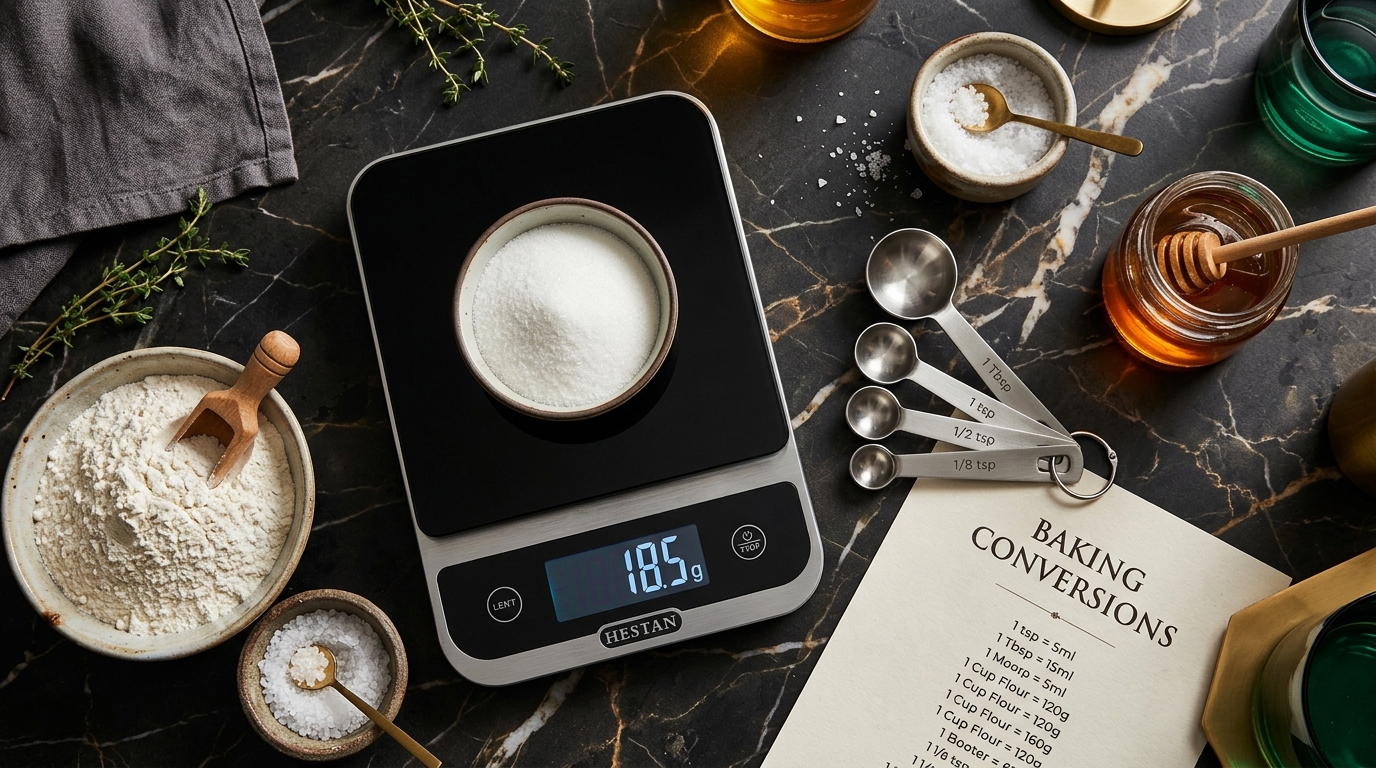
Quick answer: 1 gram ≈ 0.2 teaspoons for water and granulated sugar. But that number changes with every ingredient because grams measure mass and teaspoons measure volume. The ratio depends entirely on density.
This guide gives you three things:
- A free grams to teaspoons calculator that adjusts for each ingredient
- A printable conversion chart covering the most-searched gram amounts
- Ingredient-specific conversion notes for sugar, salt, flour, baking powder, honey, oil, and more
Whether you’re scaling a recipe, measuring supplements, or just trying to figure out how many teaspoons are in 5 grams of baking powder — this page has the answer.
Gram to Teaspoon Calculator
Our homepage converter lets you type any gram value, pick your ingredient, and get an instant teaspoon result.
How to use it:
- Enter the number of grams
- Select your ingredient from the dropdown (sugar, salt, flour, butter, etc.)
- Read the teaspoon output
The ingredient selector matters because density changes the math. 10 grams of sugar converts to a different number of teaspoons than 10 grams of flour or 10 grams of salt. A generic “grams to tsp” formula only works for water. For anything else, you need the ingredient’s density baked into the calculation.
Try the calculator now — it runs in your browser, works on any device, and costs nothing.
Gram to Teaspoon Conversion Chart
This table uses granulated sugar as the baseline (density ≈ 0.85 g/mL). It covers the gram values people search for most.
| Grams (g) | Teaspoons (tsp) |
|---|---|
| 0.1 g | 0.02 tsp |
| 0.25 g | 0.05 tsp |
| 0.5 g | 0.10 tsp |
| 1 g | 0.24 tsp |
| 2 g | 0.48 tsp |
| 3 g | 0.72 tsp |
| 5 g | 1.19 tsp |
| 10 g | 2.39 tsp |
| 15 g | 3.58 tsp |
| 20 g | 4.78 tsp |
| 25 g | 5.97 tsp |
| 30 g | 7.17 tsp |
| 50 g | 11.95 tsp |
| 100 g | 23.90 tsp |
These values assume a US teaspoon (4.93 mL). For other ingredients, the numbers shift — sometimes a lot. A teaspoon of flour weighs less than a teaspoon of sugar because flour is less dense. That’s why a single chart can’t cover everything.
Why Grams-to-Teaspoons Isn’t a Fixed Ratio
Here’s the core problem: a teaspoon is a unit of volume. A gram is a unit of mass. They measure different things.
To convert between the two, you need a bridge — and that bridge is density (mass per unit volume). Every ingredient has a different density, so every ingredient has a different gram-to-teaspoon ratio.
Think of it this way. Fill a teaspoon with feathers and weigh it. Now fill the same teaspoon with sand and weigh it. Same volume, very different mass.
Density Comparison Table
| Ingredient | Density (g/mL) | 1 gram = teaspoons | 1 tsp = grams |
|---|---|---|---|
| Water | 1.00 | 0.20 tsp | 4.93 g |
| Granulated Sugar | 0.85 | 0.24 tsp | 4.18 g |
| Table Salt | 1.22 | 0.17 tsp | 6.00 g |
| All-Purpose Flour | 0.53 | 0.38 tsp | 2.60 g |
| Olive Oil | 0.92 | 0.22 tsp | 4.51 g |
| Butter | 0.91 | 0.22 tsp | 4.49 g |
The USDA and NIST define these density standards. The FDA uses them when setting nutrition label serving sizes. These aren’t rough guesses — they’re measured values based on standard packing conditions.
So when someone asks “how many grams are in a teaspoon?” the only honest answer is: it depends on what’s in the teaspoon.
Ingredient-Specific Quick Answers
Each ingredient below gets its own conversion factor. We keep dedicated posts for the ones people search for most. Here’s a quick reference for each, with links to go deeper.
Sugar (Granulated)
One teaspoon of granulated sugar weighs about 4.18 grams. Brown sugar packs tighter and weighs more per teaspoon — roughly 4.6 g. Powdered sugar is lighter at about 2.5 g per teaspoon because it’s full of air.
Example: 10 grams of granulated sugar = 2.39 teaspoons.
Salt (Table Salt)
Table salt is denser than most dry ingredients. One teaspoon weighs about 6.0 grams. Kosher salt and sea salt are less dense because of their crystal structure, so the same teaspoon holds fewer grams.
Example: 5 grams of table salt = 0.83 teaspoons.
Baking Powder, Baking Soda & Yeast
Baking powder has a density of roughly 0.90 g/mL, so 1 teaspoon ≈ 4.44 g. Baking soda is slightly denser at about 1.10 g/mL, making 1 teaspoon ≈ 5.42 g. Active dry yeast is lighter — roughly 3.1 g per teaspoon.
Example: 1 gram of baking soda = 0.18 teaspoons (less than a quarter teaspoon).
→ Baking powder conversion guide · Yeast conversion guide
Matcha & Tea
Matcha powder is surprisingly light. One teaspoon holds about 2 grams. Loose leaf tea varies widely — black tea is denser than green tea. A typical teaspoon of loose tea weighs 2–3 grams.
Example: 5 grams of matcha = roughly 2.5 teaspoons.
→ Matcha powder conversion guide · Tea conversion guide
Honey, Oil, Vanilla & Water
Liquids are simpler because their density is more uniform. Water is the baseline: 1 tsp = 4.93 g. Honey is much denser at about 1.42 g/mL, so 1 teaspoon = 7.0 g. Vanilla extract sits close to water at roughly 4.7 g per teaspoon. Cooking oils land near 4.5 g per teaspoon.
Example: 15 grams of honey = 2.14 teaspoons.
→ Honey conversion guide · Liquid ingredient conversions
Grams to Tablespoons (Bonus Conversion)
A lot of recipes call for tablespoons instead of teaspoons. Since 1 tablespoon = 3 teaspoons, you can divide the teaspoon values above by 3 to get tablespoons.
Here’s a quick gram-to-tablespoon table using granulated sugar:
| Grams (g) | Tablespoons (tbsp) |
|---|---|
| 5 g | 0.40 tbsp |
| 10 g | 0.80 tbsp |
| 15 g | 1.19 tbsp |
| 20 g | 1.59 tbsp |
| 25 g | 1.99 tbsp |
| 30 g | 2.39 tbsp |
| 50 g | 3.98 tbsp |
| 100 g | 7.97 tbsp |
→ Full grams to tablespoons conversion guide (UK)
UK vs. US vs. Metric Teaspoon Differences
Not all teaspoons are the same size.
| Standard | Teaspoon Volume |
|---|---|
| US Customary | 4.93 mL |
| Metric (UK, AU, NZ) | 5.00 mL |
| US Legal (nutrition labels) | 5.00 mL |
The difference is small — about 1.4% between a US customary teaspoon and a metric one. For most cooking, you won’t notice it. But it compounds in larger measurements and in precise baking.
Adjusted Values for UK/Metric Readers
If you’re using a 5 mL metric teaspoon, here’s how the sugar conversion chart shifts:
| Grams (g) | US tsp (4.93 mL) | Metric tsp (5.00 mL) |
|---|---|---|
| 5 g | 1.19 tsp | 1.18 tsp |
| 10 g | 2.39 tsp | 2.35 tsp |
| 20 g | 4.78 tsp | 4.71 tsp |
| 50 g | 11.95 tsp | 11.76 tsp |
| 100 g | 23.90 tsp | 23.53 tsp |
The US Metric Association and NIST both document these measurement differences. If precision matters — and in baking it often does — know which teaspoon standard your measuring spoons follow.
→ Australia teaspoon conversions · New Zealand teaspoon conversions
Printable PDF Conversion Chart
Want a one-page chart you can stick on your fridge or slip into a recipe binder?
We’ve created a free printable grams-to-teaspoons conversion chart that covers all the common ingredients and gram values in this guide. It fits on a single letter-sized page.
Download the free printable chart →
Print it, laminate it, and keep it next to your kitchen scale and measuring spoons. It covers sugar, salt, flour, baking powder, and liquids — all on one sheet.
Frequently Asked Questions
Can grams be converted to teaspoons directly?
Not with a single formula. Grams measure mass. Teaspoons measure volume. You need the ingredient’s density to convert between the two. Our calculator handles this for you — pick the ingredient, enter the grams, get the teaspoons.
How many grams are in a teaspoon of sugar?
One US teaspoon of granulated sugar weighs about 4.18 grams. Brown sugar weighs more (about 4.6 g) and powdered sugar weighs less (about 2.5 g) per teaspoon.
Is a gram-to-teaspoon ratio the same for all powders?
No. Every powder has a different density. All-purpose flour weighs about 2.6 g per teaspoon. Cocoa powder weighs about 2.5 g. Baking soda weighs about 5.4 g. Protein powder varies by brand but usually falls between 2.5–4.0 g per teaspoon. The particle size, packing, and moisture content all affect density.
What’s the easiest way to convert without a scale?
Use our grams to teaspoons calculator. Enter the gram value, select the ingredient, and get the teaspoon equivalent. It’s the most practical approach when you don’t have a kitchen scale. That said, for baking — where precision changes the outcome — a digital scale that reads in grams gives you the most accurate results.
How do I convert grams to teaspoons for baking powder?
Baking powder has a density of roughly 0.90 g/mL. Divide the grams by 4.44 to get teaspoons. So 5 grams of baking powder ≈ 1.13 teaspoons. Baking soda is denser — divide by 5.42 instead.
Why do different websites give different conversion numbers?
Two reasons. First, some sites round more aggressively. Second, some use a generic water-based formula instead of ingredient-specific densities. The numbers in this guide use USDA density values and the NIST definition of a US teaspoon (4.92892 mL).
Key Takeaways
The gram to teaspoon conversion is never a fixed number. It depends on the ingredient’s density. Water, sugar, salt, flour, and oil all convert differently.
Here’s what to do:
- For a quick answer, use the conversion chart above
- For a precise answer, use the grams to teaspoons calculator — pick your ingredient and enter the grams
- For recipe-specific help, check the ingredient guides linked in this post
Related Guides
- Grams of Sugar to Teaspoons — granulated, brown, and powdered sugar conversions
- Grams of Salt to Teaspoons — table salt, kosher salt, and sea salt conversions
- Grams of Flour to Teaspoons — all-purpose, bread, and cake flour
- Baking Powder: Grams to Teaspoons — baking powder conversions
- Yeast: Grams to Teaspoons — active dry and instant yeast
- Matcha Powder: Grams to Teaspoons — matcha powder conversions
- Tea: Grams to Teaspoons — loose leaf tea conversions
- Honey: Grams to Teaspoons — honey and syrup conversions
- Liquid Ingredients: Grams to Teaspoons — water, oil, vanilla extract
- Dry Ingredients: Grams to Teaspoons — powders and dry goods
- Grams to Tablespoons (UK) — full tablespoon conversion chart
Bookmark this page or grab the printable chart. It’ll save you time every time a recipe mixes metric and imperial measurements.